Retention Marketing
Blog overview
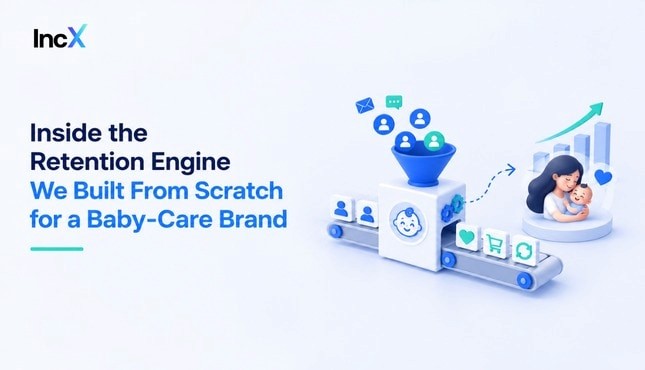
This case study shows how we built a retention engine from scratch for a baby‑care and maternity D2C brand that already had customers but no formal retention infrastructure. We started with lifecycle journeys and WhatsApp automation, then gradually added customer segmentation, behavioural triggers, restock logic and personalised communication. The goal was to turn the retention engine into a revenue engine. The article explains the step‑by‑step approach behind the system, the results it produced and the key lessons for building retention that is driven by customer behaviour rather than calendar‑based campaigns. It also shows how the same underlying mechanism can apply to SaaS, where product usage, engagement and adoption signals can guide retention interventions.

Introduction
Retention problems do not always begin with the customers leaving. Sometimes, the bigger problem is that there is no retention system in place to begin with.
That was the situation when we started working with a babycare and maternity brand. Despite operating in a category where repeat purchases are naturally possible, retention was largely unexplored. There were no structured retention journeys, WhatsApp was being used primarily for transactional communication rather than as a lifecycle channel, and there was no CRM or automation platform managing customer communication.
Most importantly, retention revenue contribution was effectively close to zero.
The challenge, however, was not simply to send more messages.
Parents are often short on time and already dealing with a high volume of information. Sending many messages could quickly cause parents to opt out. Relying heavily on discounts could also weaken parents’ long‑term trust in the brand. What a parent needs can change quickly as the baby grows.
So the objective was to build something more durable than a collection of promotional campaigns: a retention engine that could identify where customers were in their journey, respond to their behaviour, and gradually make communication more relevant.
This is a D2C case study. The product category matters because it shaped the customer journey and the communication constraints. But the underlying mechanism — moving from calendar-based communication to behaviour and intent-led retention — is relevant well beyond babycare.
The Starting Problem: High Acquisition Cost, Leaky Retention
The case study does not give a number for the customer acquisition cost, so it would be misleading to attach one to the engagement.
What it does show is a different kind of economic problem: the brand had already built a customer base, but there was almost no real way to turn those customers into repeat revenue.
The gaps were foundational:
No structured retention journeys
No effective use of WhatsApp as a revenue or lifecycle channel
Customer communication largely limited to transactional updates
No CRM or automation tool for lifecycle messaging
Retention revenue contribution effectively close to zero
That made the problem more urgent than simply having a weak campaign calendar.
If a brand has customers but does not have a system for communicating with them after acquisition, it is leaving potential repeat demand largely unmanaged.
And in this category, the answer could not simply be “send more offers.”
Parents’ needs change as their children grow. A message that is useful when a child is a baby can feel irrelevant when that child is a teenager so parents’ needs evolve with the child’s age. The brand therefore needed a way to keep communication timely and contextual yet not overwhelm customers.
The question became:
How do you build a retention engine that responds to what customers are actually doing instead of simply sending them another message because the calendar says it’s time?
That became the foundation of the work.
What We Actually Built: Step by Step
We followed a step-by-step procedure:
Step 1: Build the Foundation Before Trying to Scale Retention
The first step was not a sophisticated win-back campaign. It was infrastructure.
We introduced Bik.ai as the CRM and WhatsApp automation platform and established WhatsApp as a lifecycle channel. We deliberately did not introduce email at this stage. The goal was to focus on one high-attention channel and establish reliability, trust and clarity before trying to push repeat purchases.
That decision is important because retention engines can become unnecessarily complicated very quickly.
More channels do not automatically mean better retention. If the underlying journeys are not working, adding emails, SMS, push notifications and other channels can simply create more noise.
The first objective was therefore to make one channel work properly.
Step 2: Fix the Core Customer Journeys
After the foundation was set up the next main goal was to fix the lifecycle gaps in the customer journeys.
The team built essential journeys covering:
Order confirmation through delivery
Abandoned cart
Browse abandonment
WhatsApp opt-in welcome journey
Post-purchase thank you and check-in messages
COD confirmation
Prepaid nudges
These were deliberately treated as core hygiene journeys. That distinction matters.
A retention engine does not begin with increasingly creative campaigns. It starts by making sure important customer moments are not falling through the cracks.
After the rollout of these core journeys, overall revenue reached ₹83.5 lakh, representing a 152% increase, while Bik contributed ₹8.25 lakh, or 9.9% of overall revenue.
At this stage, the system was already doing something more valuable, than merely running isolated campaigns. The system was building an infrastructure that surrounded the customer lifecycle and that made the real difference.
Step 3: Segment Customers Before Scaling Communication
The next problem was relevance.
A customer who had recently purchased was not necessarily in the same position as someone who had lapsed. A high spender did not necessarily need the same communication as a low spender. And someone buying furniture could have very different needs from someone purchasing everyday essentials.
So the next layer was segmentation based on behaviour and value using RFM.
The segments included:
High spenders
Mid spenders
Low spenders
Recently active customers
Lapsed customers
COD buyers
Prepaid buyers
Category preferences, including furniture, essentials, fashion and gifts
This changed the role of messaging.
Instead of asking, “What campaign should we send today?”, the system could increasingly ask, “Who is this customer, what have they done and what communication is relevant to them?”
That is a fundamentally different approach to retention marketing.
Step 4: Add Intent and Restock Logic
With the basic journeys and segmentation in place, the engine could become more responsive to customer intent.
This included:
Personalised post-purchase product recommendations
Diaper restock reminders based on pack size and usage
Back-in-stock alerts
Drip campaigns for engaged users who had not converted
Category-specific win-back campaigns
The diaper restock example is particularly useful because it demonstrates the difference between calendar-triggered and behaviour or usage-triggered retention.
A generic lifecycle calendar might say:
“It has been 30 days. Send a reminder.”
A more contextual system asks:
“Given what this customer purchased, the pack size and expected usage, is there a reasonable point at which a restock reminder becomes useful?”
The latter is closer to how a retention engine should operate.
The team also introduced parenting-led journeys by asking parents their child’s age and placing them into tailored flows, such as Expecting, 0-12 months and Gift Buyers.
The result was not simply more automation. It was more contextual automation.
Step 5: Keep Campaigns in Their Place
One of the easiest mistakes in retention marketing is allowing campaigns to become the entire strategy.
That did not happen here.
Campaigns were used sparingly and were designed to support the journeys rather than replace them. The system was continuously refined based on engagement and drop-offs, while phased rollouts were preferred over large, one-time launches.
The philosophy was simple:
The journey is the engine. Campaigns are supporting components.
That distinction is what separates a retention system from a collection of promotional messages.
What Changed?
Within a few months of rollout, the brand had created a repeatable and scalable retention system instead of relying on one-off campaigns. The WhatsApp-led engine added around 10% of total revenue, with read rates between 70% and 85% and ROAS reaching up to 15x.
The case study also reports 39.7K total orders, with the retention plan helping acquire 29.85K customers. It further reports ₹8.2 lakh in total revenue against ₹35.35K in total cost, resulting in an overall ROI of 23.20x and WhatsApp-specific ROI of 23.21x.
The more important outcome, however, was structural.
The brand went from having almost no formal retention infrastructure to having a system that could be expanded and refined over time.
That is the real value of a retention engine.
Why This Works Whether You’re D2C or SaaS
The babycare example is D2C. A SaaS company has a very different customer journey, buying cycle and definition of retention.
The transferable part is not WhatsApp. It is not diaper restocking. It is not even the specific segmentation framework.
The transferable mechanism is using customer behaviour and intent to determine what happens next instead of relying entirely on a fixed communication calendar.
In D2C, a signal might be:
Purchase → expected usage → restock window → reminder
In SaaS, the equivalent could be:
Product usage → sustained decline in activity → risk signal → contextual intervention
For example, imagine a SaaS customer whose weekly usage has consistently declined after a period of strong adoption.
A calendar-based lifecycle program might continue sending the same monthly newsletter or generic product update.
A behaviour-led retention engine would treat the usage decline as a signal. The response could then be sequenced around that customer’s context; an in-product prompt, an educational message, a relevant feature recommendation, or an intervention from the appropriate customer-facing team.
The exact channel and response would depend on the product and customer relationship.
The principle remains the same:
Detect a meaningful change in behaviour → understand the customer's context → trigger a relevant response → measure what happened next.
That is why the mechanism can travel across business models even when the customer journeys themselves do not.
How to Build a Retention Engine: The Core Lessons
If you are trying to build your own retention engine, the case points to a few practical principles.
Start with lifecycle gaps, not campaigns: Fix the spots where customers are falling through the cracks before you try to add campaigns.
Choose a primary channel first: Having more channels is not always better. Make sure your primary channel is reliable and useful before you try to expand.
Segment before you scale: Using behavior, value, recency and preferences helps make your messages more relevant. This way you can stop sending messages that people do not need.
Use real customer signals: Purchase behaviour, engagement, usage and intent can all become triggers for the next interaction.
Separate journeys from campaigns: Journeys build the core system that keeps customers. Campaigns should help that system not replace it.
Treat communication as a customer experience: Keeping customers happy is easier when messages feel helpful instead of pushy.
Keep refining the system: The case study used phased rollouts, checked how people engaged and looked at where people stopped to keep the journeys better.
The biggest lesson from this engagement is perhaps the simplest:
Retention works best when it feels like guidance, not marketing.
Conclusion
The babycare category created a particular set of challenges, but the retention mechanism we built was not dependent on babycare.
What is transferable is the operating model:
Find the gaps in the customer lifecycle.
Build the foundational journeys first.
Use customer behaviour to make communication more relevant.
Introduce segmentation before scaling.
Add intent and usage logic where the business allows it.
Use campaigns to support journeys rather than replace them.
Continuously review engagement and drop-offs.
Optimize for usefulness, not message volume.
That is the foundation of how to build a retention engine that can keep improving over time.
A D2C brand might use purchase behaviour and restock logic.
A SaaS company might use product usage and adoption signals.
The vertical changes. The mechanism does not.
FAQ
Does this same approach work for subscription SaaS?

What's the minimum data you need to start?
How long did this engagement take to show results?
Want to turn customer behaviour into a retention engine?
Let’s map out the journeys, signals, and automation your business needs to drive stronger retention and repeat revenue.
Explore our Growth Marketing Services or Talk to Our Team to get started.