B2B SaaS Marketing
Blog overview
Choosing the right B2B SaaS marketing agency can significantly impact your growth trajectory. This guide helps founders evaluate agencies based on SaaS expertise, proven results, team structure, pricing, and client feedback, ensuring they select a partner capable of driving sustainable pipeline and revenue growth.

Most SaaS founders tend to regret their first agency hire and this guide ensures that you end up not feeling the same:
Get this, you've built something tangible and there's an actual product-market fit happening with customers paying you money, but now you've unfortunately hit a wall with growth. Everything depends on you personally: LinkedIn messages, founder-led sales, occasional referrals. You must scale past this, which is when hiring a B2B SaaS marketing agency starts looking like the safest of routes to take.
You begin searching. Google brings up dozens of results, you ask acquaintances and agencies find you somehow. Within a week you're drowning in proposals and adverts that all say the same thing: "We specialise in growth for SaaS companies exactly like yours."
Fast forward 6 months, you are now locked into a retainer with an agency producing professional-looking reports, everything looks exceptional on paper, except your pipeline hasn't progressed. The provided content could apply to any SaaS company, campaigns are missing targets. Turns out their SaaS expertise is limited to two case studies from 2019 and extremely confident presentations.
This happens constantly and this guide makes sure it doesn't happen to you.
This is for Seed through Series B founders making this call for the first time, or making it again after expensive lessons.
Why Most SaaS Founders Hire the Wrong Agency
Mistaking Reach for Results
Large agency websites make strong impressions by highlighting logos of influential clients, including polished case studies with nice dashboards and team pages listing 20 people with titles like "Director of Growth Strategy."
None of that tells you whether this agency can drive growth for your particular business, at your specific stage, with your shortcomings and strengths.
Reach often gets confused with capability, but:
Staff size signals resources, not alignment
Client scale shows polish, not fit for your stage
Tech stack sophistication indicates tools, not strategy match
Big budgets and big teams solve different problems than yours
The truth: An agency that ran demand gen for a $50M ARR company with 200 employees and a $2M budget hasn't proven they can drive pipeline for your $500K ARR startup on a $15K monthly retainer. Those are completely different problems.
The question that actually matters: Have they delivered measurable growth for companies at your stage, selling to your type of buyer, with similar constraints? That list gets way shorter.
Hiring Generalists When You Need SaaS Specialists
"We do B2B marketing" sounds close enough to "we do B2B SaaS marketing" until you're three months into realising that they're not remotely close. SaaS contains specific dynamics such as:
product-led growth motions
trial-to-paid conversion
expansion revenue
usage-based pricing messaging
self-serve onboarding as a marketing channel
A generalist B2B agency excellent at demand gen for professional services won't automatically understand SaaS unit economics, why CAC payback matters more than MQL volume, or how to message a freemium model that confuses enterprise buyers expecting traditional sales.
Only people who've been deep in the SaaS trenches can guide you through the SaaS Maze.
The "Dead Zone" Statistics: Why Most Hires Fail by Month 3
If you feel like you’re burning cash in the first quarter, know that there’s hundreds feeling the same and you’re all likely hitting the industry "Dead Zone."
According to recent B2B benchmarks, the gap between "marketing activity" and "actual revenue" is wider than most agencies admit:
The 13% Trap: Only about 13% of Marketing Qualified Leads (MQLs) usually convert to Sales Qualified Leads (SQLs) in the average SaaS funnel. If your agency is bragging about lead volume but your calendar is empty, they are likely funding the 87% of activity that never reaches Sales.
The Conversion Gap: Research shows that 79% of marketing leads never convert to sales and this is all because agencies tend to prioritise volume over fit to make their monthly reports look "green."
The 60-Day Blackout: The first 60 days paired with most agencies are consumed by technical onboarding, alignment and discovery. If clear Leading Indicators like high-intent demo requests vs. ebook downloads, are not explicitly defined, you are guaranteed to hit month 6 before realising the pipeline hasn't moved an inch.
The takeaway for founders: Don't measure an agency by the commotion and impact they create in the first 90 days. It is safe to measure them by the quality of the handoff to your sales team. Proceeding with a framework that benefits your agency holistically is the only way to secure success.
The Agency Tested and Founder Approved Framework
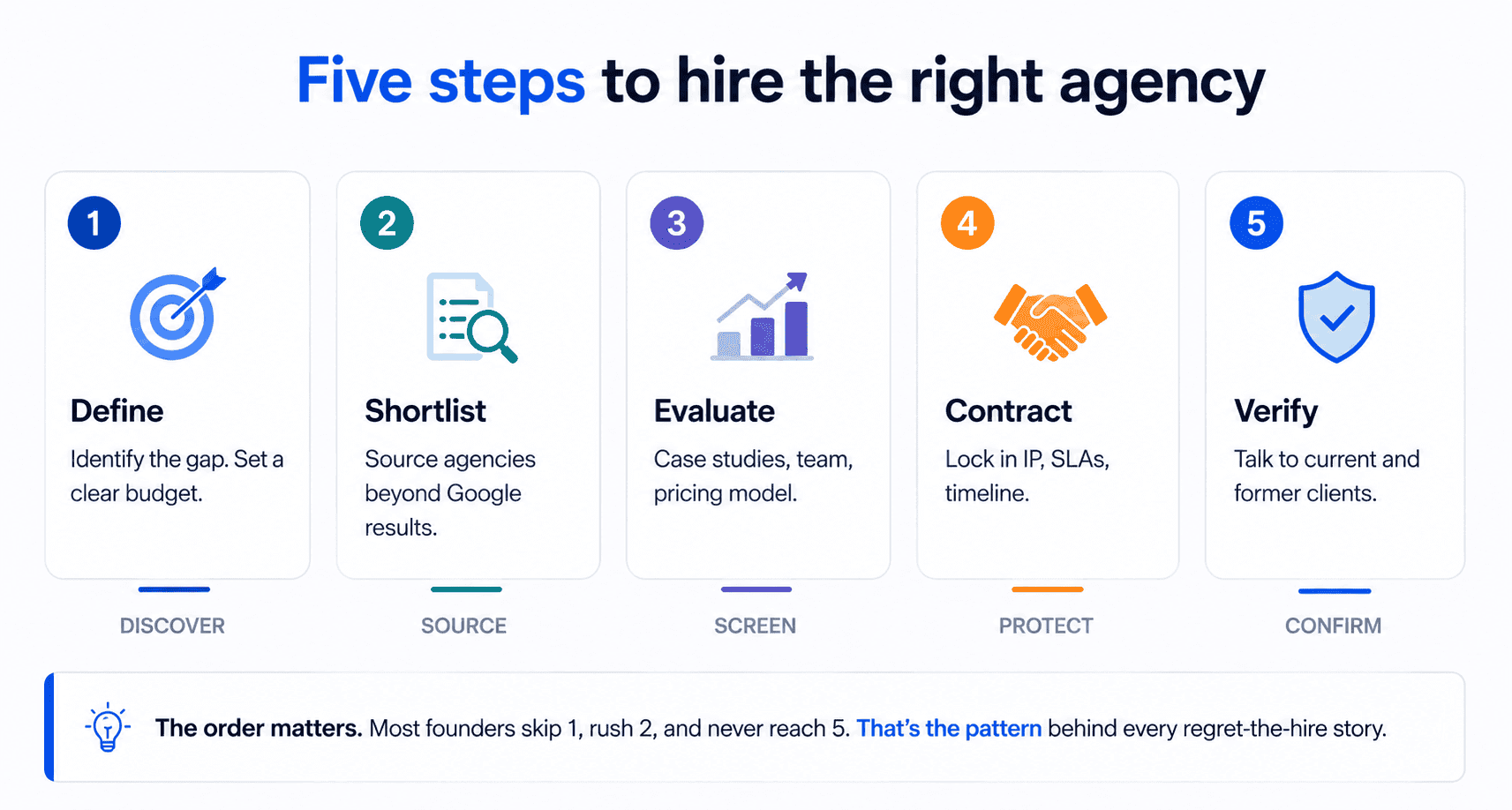
Step 1: Define What You Actually Need Before You Search
Most founders rush to start with "we need marketing help!" and let specifics emerge during agency calls. This hands control to agencies, who then recommend whatever services they offer and can benefit from greatly.
You must learn to define the gap yourself first.
GTM vs Demand Gen vs Content: Clarify the Gap First
Modern Problems require Modern Expertise.
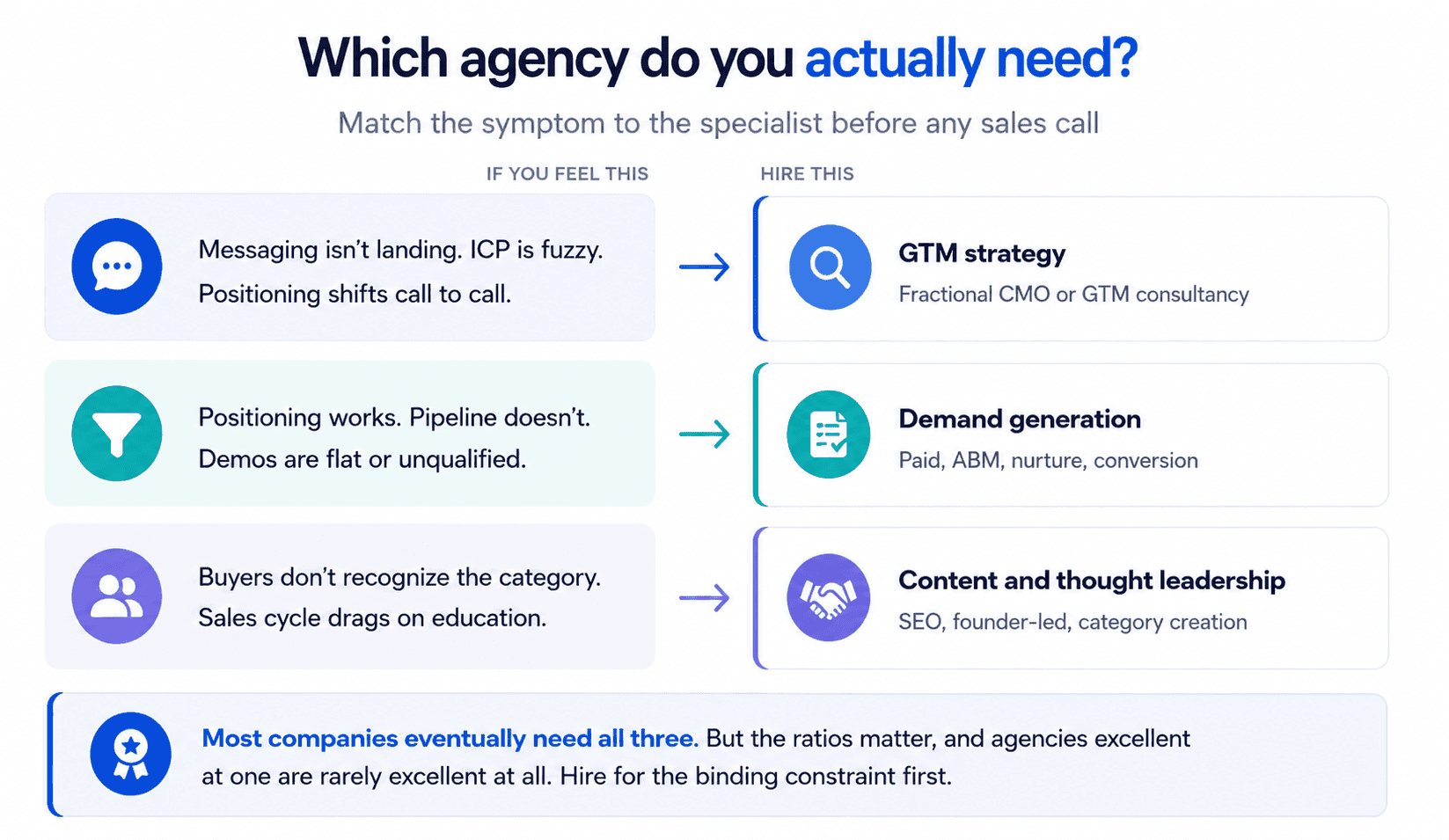
GTM strategy: If your messaging is not landing, positioning feels unclear, or ICP is not defined, the issue is not execution. It is direction. This calls for strategic support such as GTM consulting or a fractional CMO before scaling anything.
Demand generation: If your positioning is solid, your priorities must shift to pipeline. You require demand gen specialists executing: paid acquisition, ABM, conversion optimization, nurture sequences.
Content and thought leadership: A sales cycle runs very long. The buying process is education-heavy and hence prospects need to understand a new category before taking calls. You need content expertise revolving around SEO-driven strategy, founder-led thought leadership and maybe category creation.
Most companies eventually need all three, but ratios matter, and agencies excellent at one are rarely excellent at all. Find out what gap has the highest level of constraint right now.
Setting a Realistic Budget and Timeline
Agencies with sizable experience in the SaaS industry will generally charge between $8,000-$25,000 monthly depending on how far along in the business they’re working with their clients.
$8,000-$12,000 covers focused implementation of two or fewer channels (Paid search, content, or nurture). $12,000-$18,000 covers multiple channel implementation along with some strategic guidance. $18,000-$25,000 covers full funnel ownership with experienced personnel.
Under $8,000 usually means junior execution or limited scope. Way over $25K at an early stage means funding overhead you don't need.
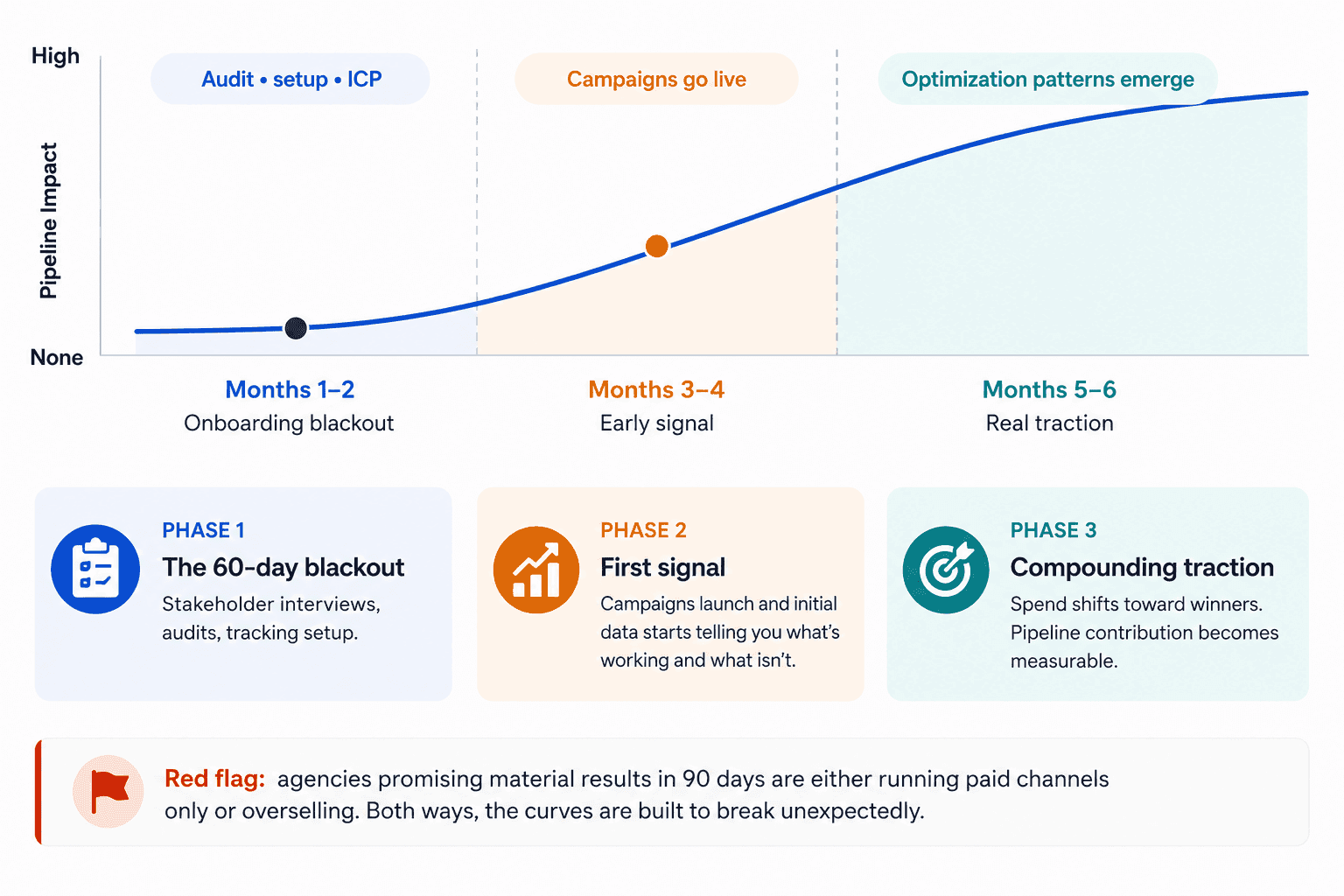
Timeline reality: Meaningful Traction takes four to six months minimum:
The first 60 days are onboarding, research, setup, not results.
Months three and four launch campaigns and generate initial data.
Months five and six show optimisation patterns.
When agencies promise material results in 90 days, they're either running paid channels exclusively (which moves fast but won't build durable growth) or overselling.
Step 2: Build Your Agency Shortlist
Where to Find Vetted SaaS Agencies Beyond Google
Searching "B2B SaaS marketing agency" gets you numerous results with identical positioning, all optimised for that query. What you get here is an SEO driven result rather than a client & market oriented list of resources.
Better sources:
Founder networks: Enquire in Slack communities or YC batch groups. The founders who've hired agencies tell you what worked versus what looked good in pitches, this is unfiltered feedback you won't get from case studies.
Investor and CFO networks: Your investors work with portfolio companies at similar stages and can provide information on which agencies delivered ROI versus which burned retainers.
Category-specific communities: You can connect with specific communities such as SaaS Growth, Demand Curve and Pavilion that maintain a vetted directory of founders reviewing agencies based on real-world experience.
LinkedIn reverse engineering: Find five to ten SaaS companies at your stage growing well, check G2 review volume, hiring patterns, fundraising and look into who runs marketing. If "Head of Demand Gen" joined recently from an agency, investigate that agency.
Aim for four to six maximum, anything more makes evaluation a full-time job.
Screening Agency Websites in 10 Minutes
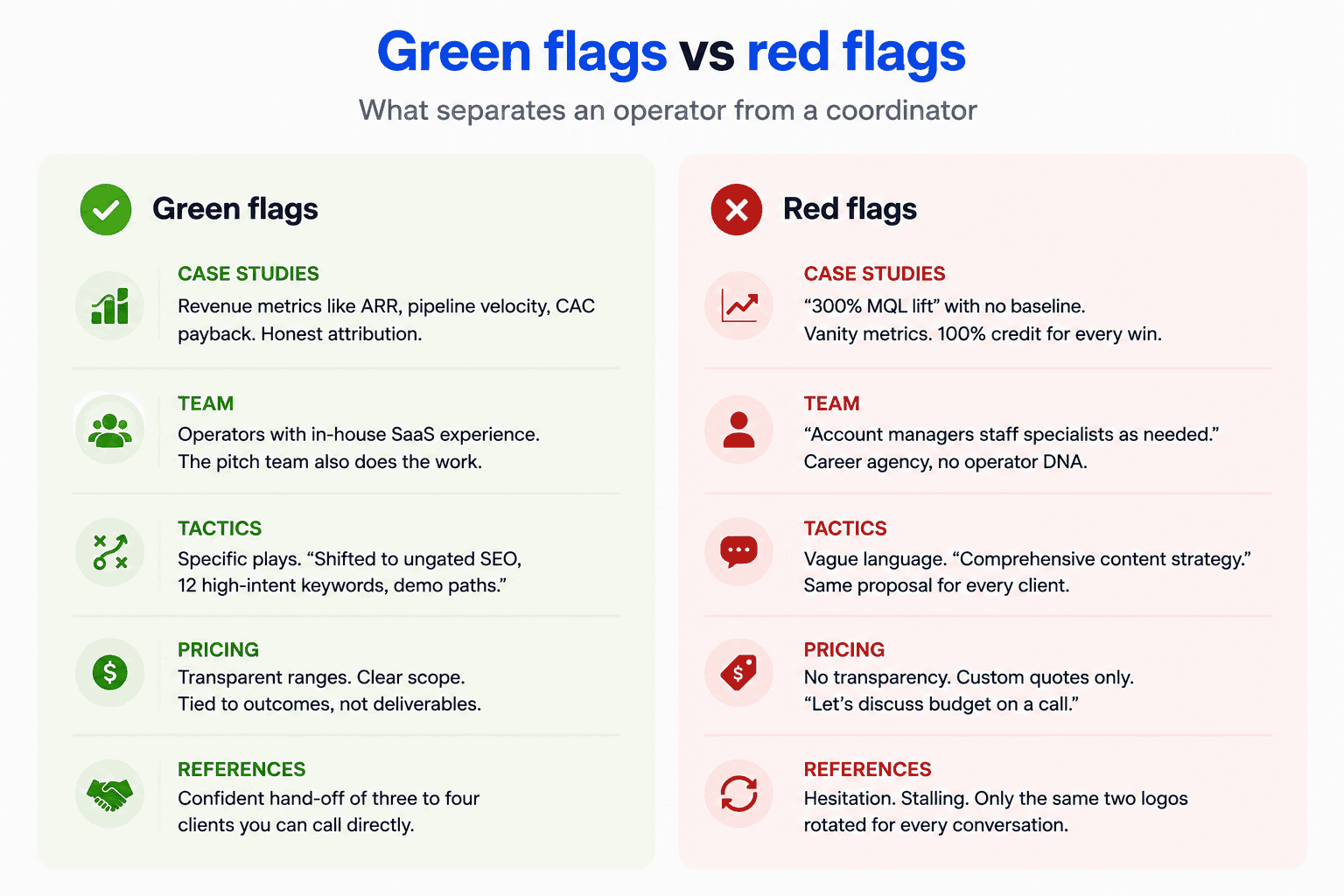
Case studies with real numbers: "Increased MQLs by 300%" is meaningless without a baseline, timeframe, or context. Look for starting ARR, timeline, specific tactics, results tied to revenue metrics like pipeline and CAC payback, not vanity metrics.
Team background: Do seniors have operating experience at SaaS companies, or are they career agency folks? Operating experience means they've felt missed pipeline pressure, not just reported on it.
Thought leadership: Do they publish content showing deep SaaS knowledge, or generic "10 B2B Marketing Tips"? Public thinking quality correlates with client work quality.
Stage-appropriate clients: If every logo is Series C+ and you're Seed, their processes won't translate, try to look for stage matches.
Red flags: Lack of pricing transparency, lack of metrics in their case studies, use of stock photos on their website, and having a 2018-looking website.
Step 3: The Evaluation Framework
Once you’ve narrowed down credible agencies to collaborate with, the next step is to get a better understanding of how that agency is set up for scaling your company. Use these three pillars to evaluate if a B2B SaaS marketing agency is actually built to scale your startup.
Take this as your SaaS marketing agency checklist before you finalise anything.
SaaS-Specific Case Studies: What to Look For
Let us focus on the statistics. Request two or three case studies from companies at your specific stage (e.g., Seed or Series A) and evaluate them with a skeptical eye:
Metrics: Did they move revenue metrics like ARR, pipeline velocity, or CAC payback? Or are they boasting about "activity metrics" like MQLs and web traffic? Founders care about economics whereas marketing managers care about activity. Choose your path carefully.
Attribution honesty: A good agency will candidly separate their impact from your organic growth or a lucky break from your sales team. If they flaunt a 100% credit for every success story, they are overselling themselves to appeal to you.
Motion alignment: Scaling a product-led freemium model from $5M to $20M requires a completely different playbook than helping a $500K sales-led motion reach its first $2M. Ensure their achievements match your growth motion and constraints.
Tactical specifics: Steer away from agencies that offer vague success stories like "comprehensive content strategy." You want to hear: "We shifted from gated eBooks to ungated long-form SEO, targeted 12 high-intent keywords, and built conversion paths to demos rather than newsletters."
Team Structure: Operators or Just Account Managers?
This is the single biggest point of failure in the agency world. You buy the "A-Team" during the sales process, but you get the B-Team led by the ‘Account Manager,’ once the contract is signed.
Ask: "Who is in charge of my account daily, and what are their credentials?"
What you want to hear: "Your lead is a dedicated strategist who ran demand gen at [SaaS Company], supported by a content lead who was an early marketing hire at [SaaS Startup]."
The Red Flag: "You’ll work with our account management team, and we staff specialists as needed." Translation: You are paying for a project manager to coordinate juniors. You want owners who have done this several times, not coordinators.
Pricing Models: Retainer, Performance, or Hybrid?
While monthly retainers are the industry standard for predictability, the structure of that retainer dictates the agency's behavior.
Model | Pros | Cons |
|---|---|---|
Fixed-Scope | Predictable output and budget. | Incentivises "checking boxes" over hitting results. |
Flexible/Agile | Can pivot swiftly based on data. | Requires active management; "scope creep" is common. |
Performance Hybrid | Aligns incentives and functioning with your growth. | Often fails in early-stage SaaS due to messy and rushed attribution. |
Step 4: Contract & Onboarding Non-Negotiables
Critical Contract Terms
IP Ownership: You must have access to everything, from content, creative, strategy docs, to ad account data.
Tool Transparency: The agency should work inside your HubSpot, your LinkedIn Ads, and your GA4. If they leave, you keep the history.
Termination: A 30-day notice period after an initial 90-day "ramp-up" period is standard and fair.
The Onboarding Roadmap
Weeks 1-2: Stakeholder interviews and a deep-dive audit of current data.
Weeks 3-4: Customer research (actual win/loss calls) and competitor gap analysis.
Month 2: The "Strategy Launch" : Priorities, 90-day roadmap, and baseline KPIs.
Step 5 : Clients Over Case Studies
Any agency that is worth spending your time and capital over, will have at least three to four clients ready to vouch for the services and outcomes. If you observe hesitation in the majority of the interactions, know that something or the other went wrong.
This step is often overlooked by founders because it all seems time-consuming and irrelevant but this is where they can save themselves from getting into a deal they might end up regretting.
Every single line of the case study you were handed is within the control of the agency and they highlight only those areas which favour them. An actual conversation with somebody engaged in the process will give you the unfiltered version about: whether the senior team actually showed up after the contract was signed, what month two really looked like, and how they responded when something wasn't working.
How to ask: Be direct. Tell them you'd like to speak with two or three founders at a similar stage before moving forward. A confident agency will respond immediately with names. Once you manage to get on those calls, skip the formal script and ask:
Did the attention and quality hold up past the first 60 days?
Who was actually doing the work, the people from the pitch, or someone else altogether?
What went wrong, and how did they handle it?
Knowing what you know now, would you sign with the agency again?
Remember to do your own digging too. Relying on testimonials will not get you everything you need.
Choosing a B2B SaaS marketing agency is one of the most consequential decisions you'll make this year. They will shape your market perception and determine if you hit the growth targets needed for your next raise. Take your time, ask the hard questions, and verify every claim.
IncrementumX is a full-stack GTM growth firm that partners with early-stage B2B founders to build revenue systems that scale.
We partner across the entire GTM value chain including Strategy, ICP Definition and Positioning, Demand Generation, Digital Marketing and Sales Enablement to deliver Operator Level Thinking across all engagements. Whether you are trying to perfect your messaging, expand your pipeline or scale beyond founder-led growth, we can act as your trusted partner through each step along the way from Seed Stage through Series B!
Still Not Sure If You Need a SaaS Marketing Agency Yet?
Before signing a retainer, get a second opinion.
Our team will review your GTM strategy, demand generation efforts, positioning, and growth bottlenecks and identify the highest-impact opportunities for growth.