Go-To-Market (GTM) Strategy
Blog overview
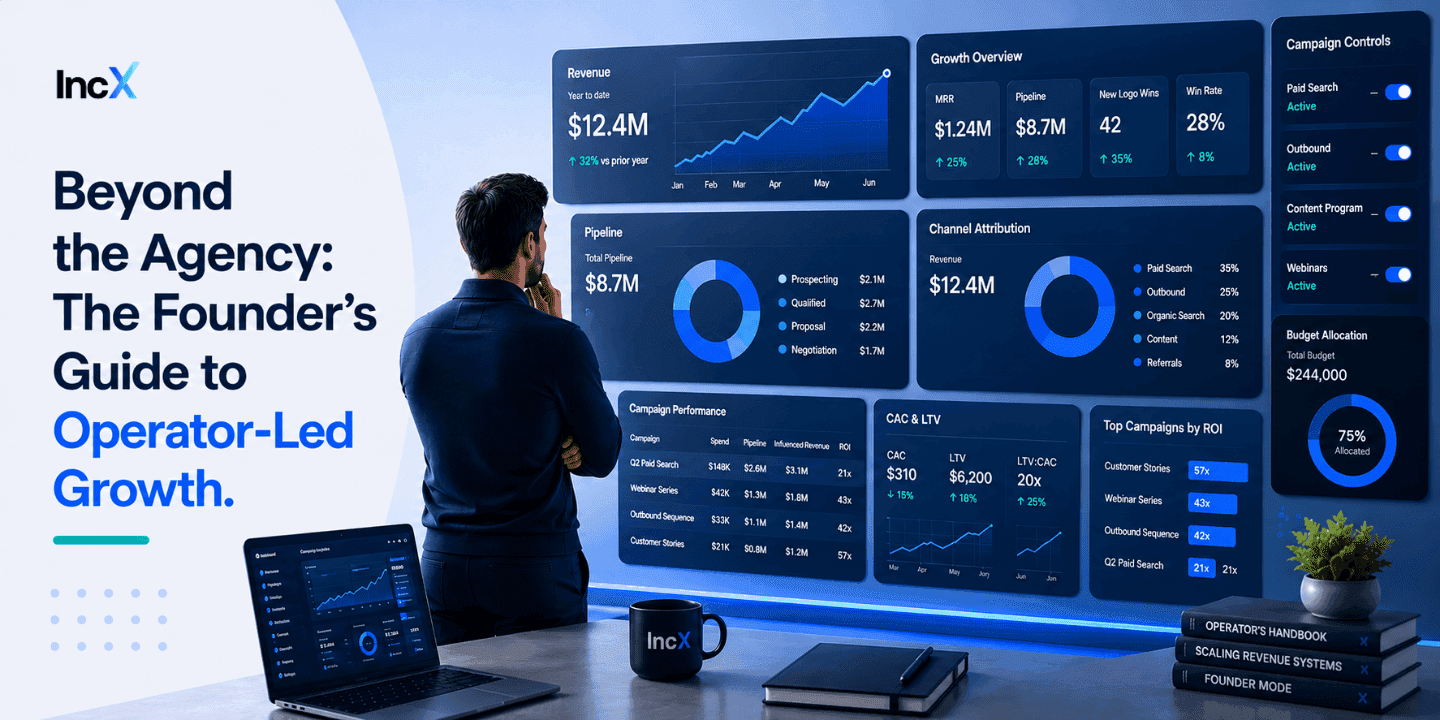
In today’s capital-efficient startup ecosystem, growth is no longer driven by strategy decks alone—it demands fast, revenue-focused execution. This blog explores why traditional growth agencies often fail funded startups and how **Operator-Led Growth** is emerging as a smarter alternative. Learn how embedded operators help startups sharpen GTM strategy, reduce CAC, improve execution speed, and build scalable revenue engines designed for long-term growth.

Introduction
For years, the standard “Series A Playbook” was simple:
Raise capital
Hire a reputable growth agency
Wait for the dashboard to turn green
But in today’s capital-efficient market, that model is fundamentally broken.
Founders are increasingly frustrated. They find themselves stuck in a cycle of paying high retainers for “strategic advice” and polished slide decks, while their actual customer acquisition costs (CAC) spiral out of control. The problem isn’t necessarily the marketing; it’s the delivery vehicle.
This is where Operator-Led Growth enters the frame. It is not just a new service; it is a new category of execution designed to close the gap between high-level strategy and daily technical grind.
What is Operator-Led Growth? (A New Category Explained)
At its core, Operator-Led Growth is the practice of embedding seasoned startup veterans directly into your leadership and execution layers. Unlike an agency that treats your company as one of twenty “accounts,” an operator treats your company as their own mission.
Operators vs. Consultants vs. Traditional Agencies
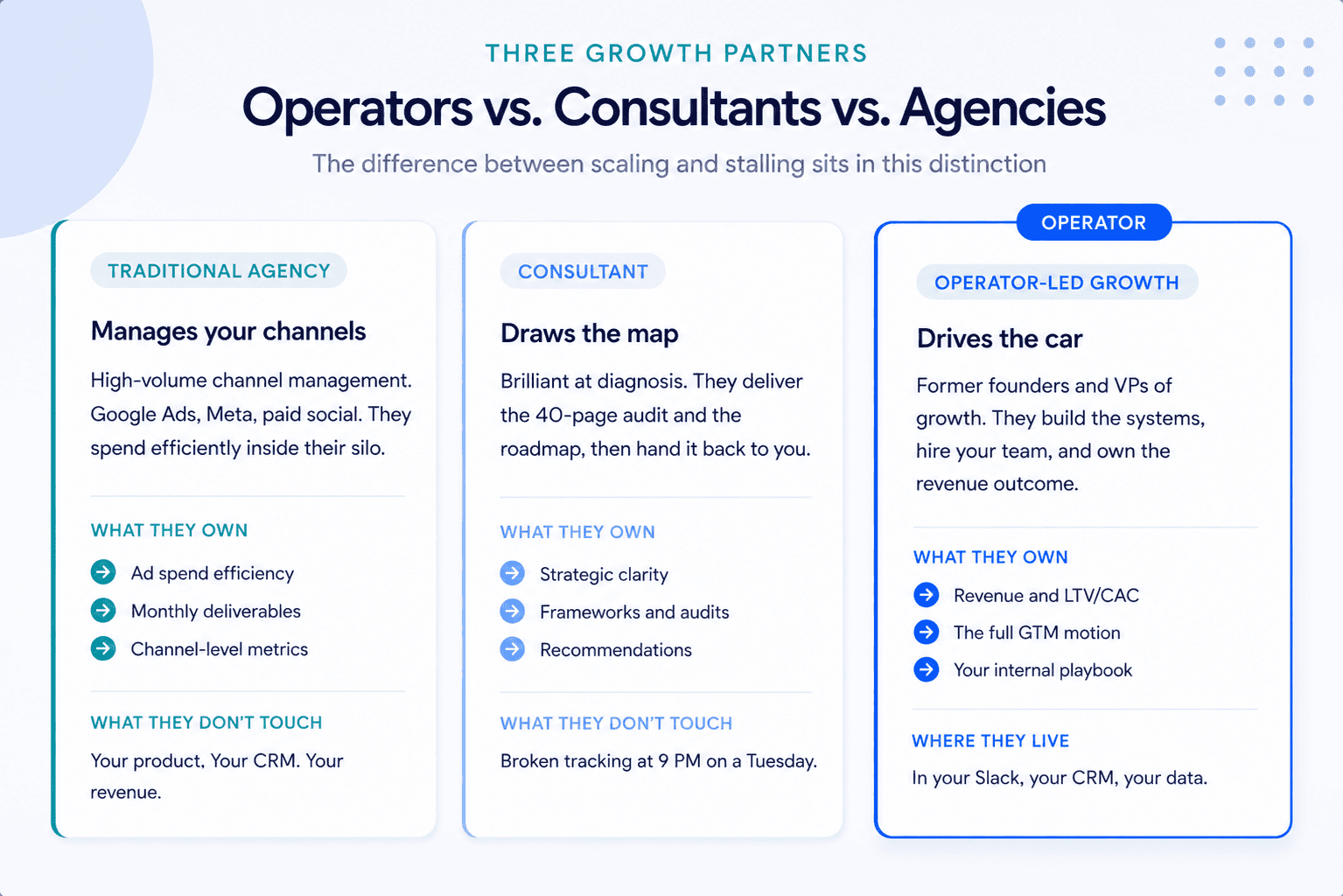
The market is currently flooded with different growth partners. Understanding the nuance between them is the difference between scaling and stalling.
Traditional Agencies: Often focused on high-volume channel management (Google Ads, Meta). They prioritize spending your budget efficiently within their specific silo but rarely touch your product or sales CRM.
Consultants: Brilliant at identifying what is wrong. They provide the 40-page audit and the roadmap, but they aren’t there at 9 PM on a Tuesday to actually fix the broken attribution tracking.
Operators: These are former founders or VPs of growth. They don’t just provide the map; they drive the car. They build internal systems, hire your permanent team, and own the revenue outcome.
Why Execution Depth Matters More Than Strategy Decks at Early Stage
In the “Zero to One” phase or the pre-seed stage, strategy is a commodity. Execution is the scarcity. A strategy deck might say, “We need to focus on market development strategy in the Fintech sector.” An operator says, “I have rewritten the cold email sequences, integrated them with HubSpot, and qualified the first ten leads myself to prove the script works.”
Comparison Table: Choosing Your Growth Engine
Feature | Operator-Led Model | Traditional Agency | In-House Team (Early) |
|---|---|---|---|
Onboarding Speed | Immediate (Days) | Slow (4-6 Weeks) | Slow (Hiring takes months) |
Accountability | Revenue & LTV/CAC | Monthly Deliverables | Employment Contract |
Integration | Embedded in Slack/Product | External Portal/Email | Full-Time |
Scope | Cross-Functional (GTM) | Channel-Specific | Tactical Execution |
Knowledge Transfer | Builds your internal playbook | Keeps knowledge in-house | High risk if they quit |
The 5 Principles of an Operator-Led Growth Model
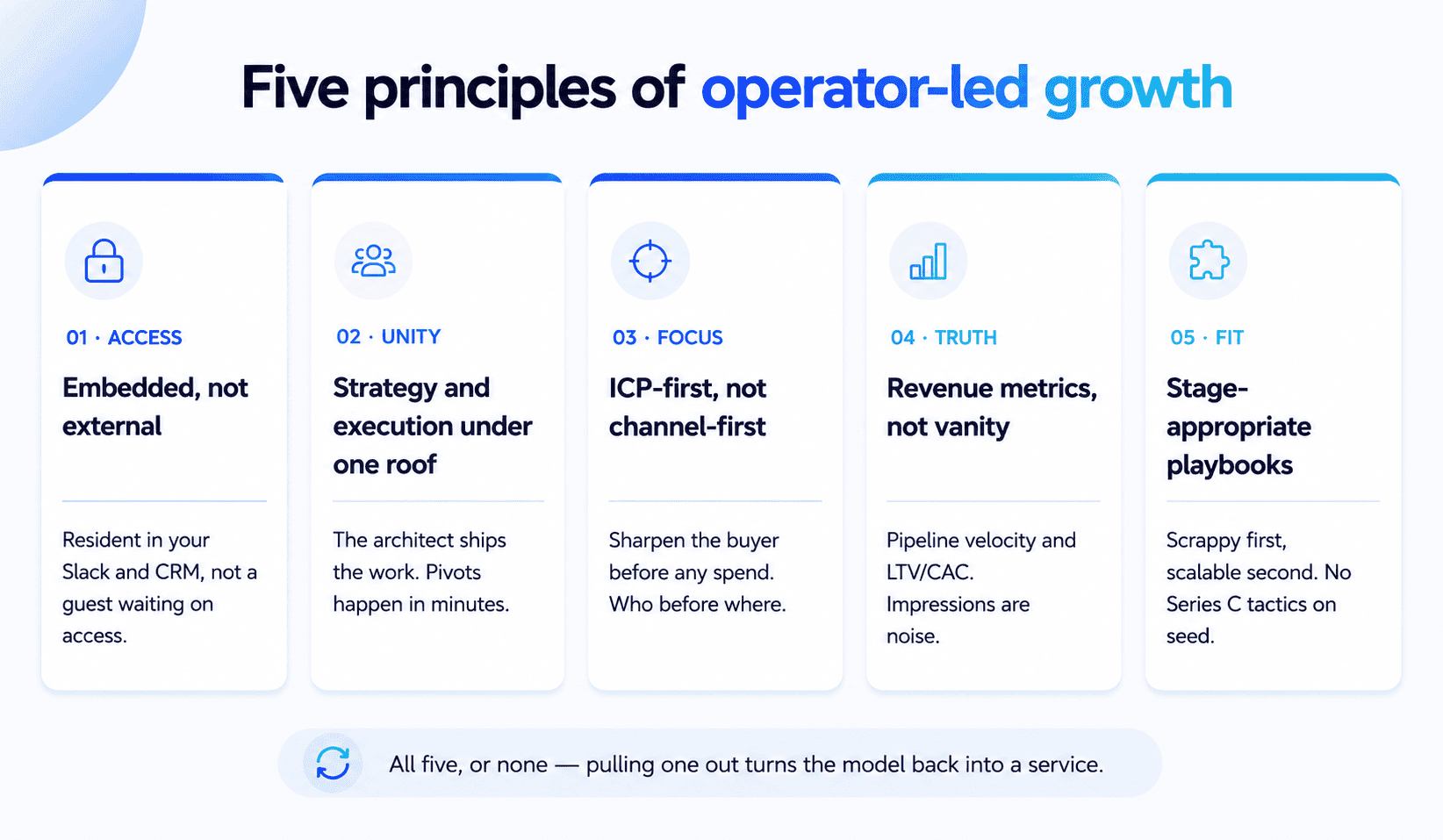
For an Operator-Led Growth strategy for B2B SaaS startups to be effective, it cannot be treated just as a “service.” It must be a fundamental restructuring of how your company communicates and executes. These five non-negotiable principles form the bedrock of the Operator-Led Growth Playbook.
Principle 1 – Embedded, Not External
The traditional agency relationship is defined by “The Wall.” You send a request over the wall; the agency sends a report back. This lag is where growth dies.
Institutional Access: An operator isn’t just a “guest” in your startup, they are a “resident” in your Slack, your CRM, and your data warehouse. They don’t wait for "permission to view”; they are integrated into the decision-making flow.
Spotting the Leaky Buckets: Since an operator has the access to see your raw sales recordings and your unedited churn data, they can identify issues an agency would ignore. If an agency sees a drop in conversions, they might suggest more ad spend. An operator sees the same drop, listens to a sales call, and realises the market development strategy is targeting the wrong persona entirely.
Cultural Alignment: Being embedded means the operator feels the “burn” of a missed quarter alongside the founder. This skin-in-the-game approach ensures that the embedded growth team for startups is focused on survival and scale, not just hitting a monthly retainer quota.
Principle 2 – Strategy And Execution Under One Roof
In large agencies, the “strategist” is often a senior executive who hasn’t touched the Facebook Ads Manager or a HubSpot workflow in five years. They hand their high-level vision to a junior associate who executes it without understanding the “why.”
The Single Point of Failure/Success: In an operator-led growth model, the person architecting the startup growth execution model is the same person clicking the “launch” button in an ad campaign. This ensures that the nuance of the strategy is preserved in the tactical execution.
Real-Time Pivoting: When an execution reveals a flaw in the strategy (which usually happens daily in an early-stage startup), the operator can pivot instantly. There is no need for a “change of order” or a strategy realignment meeting. The feedback loop is shortened from weeks to minutes.
Technical Sovereignty: By having strategy and execution combined, the operator ensures your technical stack is built to support your long-term goals, preventing the “Frankenstein stack” that usually results from multiple external vendors.
Principle 3 – ICP-First, Not Channel-First
Most agencies often start with: “Which channel should we spend money on?” This is a backward approach that often leads to the high failure rates seen in pre-seed marketing.
Whereas, Operators start with: “Who is the customer, what is their plan, and where do they hang out?” They sharpen the Ideal Customer Profile (IPC) before a single penny is spent on media.
Here’s how an operator-led growth differs:
Deep Discovery: Operators start with the “who.” They conduct Ideal Customer Profile (ICP) sharpening by interviewing your happiest costumes and your most painful churns.
The Plan over the Platform: Before picking a channel, the operator maps out the customer’s internal struggle. What is their plan for the year? Where do they hang out?
Strategic Patience: This principle requires the “Strategic Patience” to spend three weeks on research in order to ensure that the next six months of spending aren’t wasted. It is the difference between “spraying and praying” and a surgical market development strategy.
Principle 4 – Revenue Metrics, Not Vanity Metrics
Traditional agencies love “Top of Funnel” metrics because they are easy to manipulate. “We increased traffic by 400%!” sounds great until you realise none of that traffic has a budget.
An Operator-Led Growth agency focuses on the marketing strategy decks vs. revenue driven execution divide, ensuring every action contributes to the bottom line.
The MQL vs. SQL Divide: An operator-led growth agency ignores impressions and click-through rates (CTR) unless they correlate directly to revenue. They bridge the marketing strategy decks vs. revenue driven execution divide by focusing on the Pipeline Velocity and Customer Lifetime Value (LTV).
Sales-Marketing Unity: Because they focus on “closed-won” revenue, operators are often found in the Sales CRM more than the Marketing dashboard. They optimize for the quality of the lead, even if it means lower lead volume, to ensure the sales team isn’t wasting time on “tire kickers.”
Full-Funnel Responsibility: The operator owns the outcome from the first click to the signed contract and the subsequent renewal.
Principle 5 – Stage-Appropriate Playbooks
One of the biggest killers of funded startups is “premature scaling”; applying a Series C playbook (heavy brand spend, massive team, complex automation) to a seed-stage problem.
Operators use “scrappy” playbooks for early stages; focusing on unscalable things that build a foundation, then transitioning to scalable automation as the company matures.
Doing the Unscalable: Early on, an operator might suggest manual outbound or one-on-one founder selling. These “scrappy” playbooks build the foundation of truth that later becomes the automated engine.
The Shift to Automation: Only once a manual motion is proven to drive revenue, does the operator transition to scalable automation.
Right-Sized Resourcing: An operator knows that a $2M seed round does not justify a $50K/month ad spend. They ensure that your growth spend is proportional to your runway and your current level of product-market fit.
Traditional Agency Principle | Operator-Led Principle | Impact on Startup |
External Vendor | Embedded Partner | Higher trust, faster execution |
Siloed Strategy | Unified Strategy & Execution | Zero "Broken Telephone" errors |
Channel-First | ICP-First | Reduced CAC; higher lead quality |
Vanity Metrics | Revenue Metrics | Positive ROI; clearer board reporting |
Template Playbooks | Stage-Appropriate Playbooks | Capital preservation; sustainable scale |
Why the Traditional Agency Model Fails Startups
The statistics in the startup world are sobering: roughly 33% of seed-funded companies fail to raise a Series A. While product-market fit is often cited as the primary cause, marketing execution gaps are a silent killer. Most startups don't die because they have a bad product; they die because they couldn't build a sustainable, repeatable way to acquire customers before their runway expired.
The “Deliverables Without Foundation” Problem
Traditional agencies operate on a “Scope of Work” (SOW) based on assets. They are incentivized to produce deliverables like, blogs, social media posts, ad creatives, and monthly reports, because that is the currency of their billing.
Expensive noise: If your core GTM foundation is cracked, for instance, your landing page doesn’t convert, or your messaging doesn’t resonate, or your attribution is broken, then every penny spent on agency “deliverables” is just expensive noise.
The Incentive Gap: An agency's success is often measured by whether they finished the video or published the blog post on time. An operator’s success is measured by whether those assets actually drove revenue.
Why Large Agencies Aren’t Built for Speed at Seed/Series A
In a funded startup, speed is the only unfair advantage you have against incumbents. Large agencies, however, are built for "Retention" and "Stability."
The 12 Months vs. 12 Days Conflict: Most agencies want you to sign a 12 months contract to provide “predictable” results. A startup needs to find what works in 12 days. In the time it takes an agency to onboard a client and finish their “discovery phase,” an operator could have run three different A/B tests on a primary value proposition.
Bureaucratic Friction: The hierarchy of a large agency is the antithesis of startup speed. A creative change or a budget pivot often has to go through an Account Manager, a Creative Director, and a VP before it reaches the person actually clicking the buttons. In an operator-led growth model, that pivot happens in a Slack message.
Junior Talent, Senior Prices: The “bait and switch” is a common agency trope. You are sold by the charismatic Senior Partner, but your account is managed by a junior associate with less than two years of experience. A startup at the seed stage cannot afford to be someone’s “learning account.”
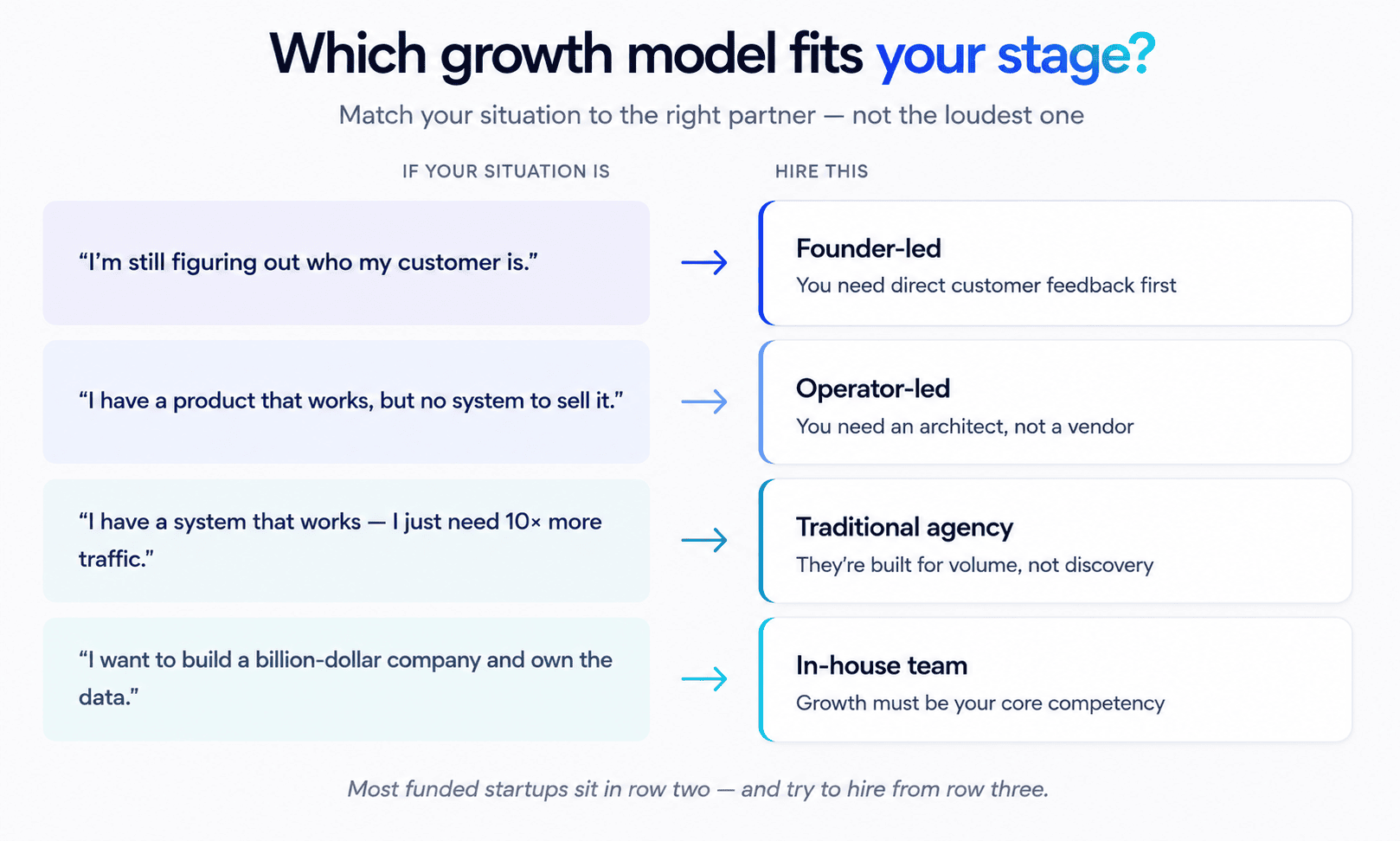
Flowchart: “Which Growth Model Is Right For Your Stage?”
How Operator-Led Growth Works in Practice: The 3-Phase Journey
While an agency provides a “service,” an operator provides a “system.” This system is built through a rigorous, three-phase framework that bridges the gap between a founder’s vision and a scalable revenue engine.
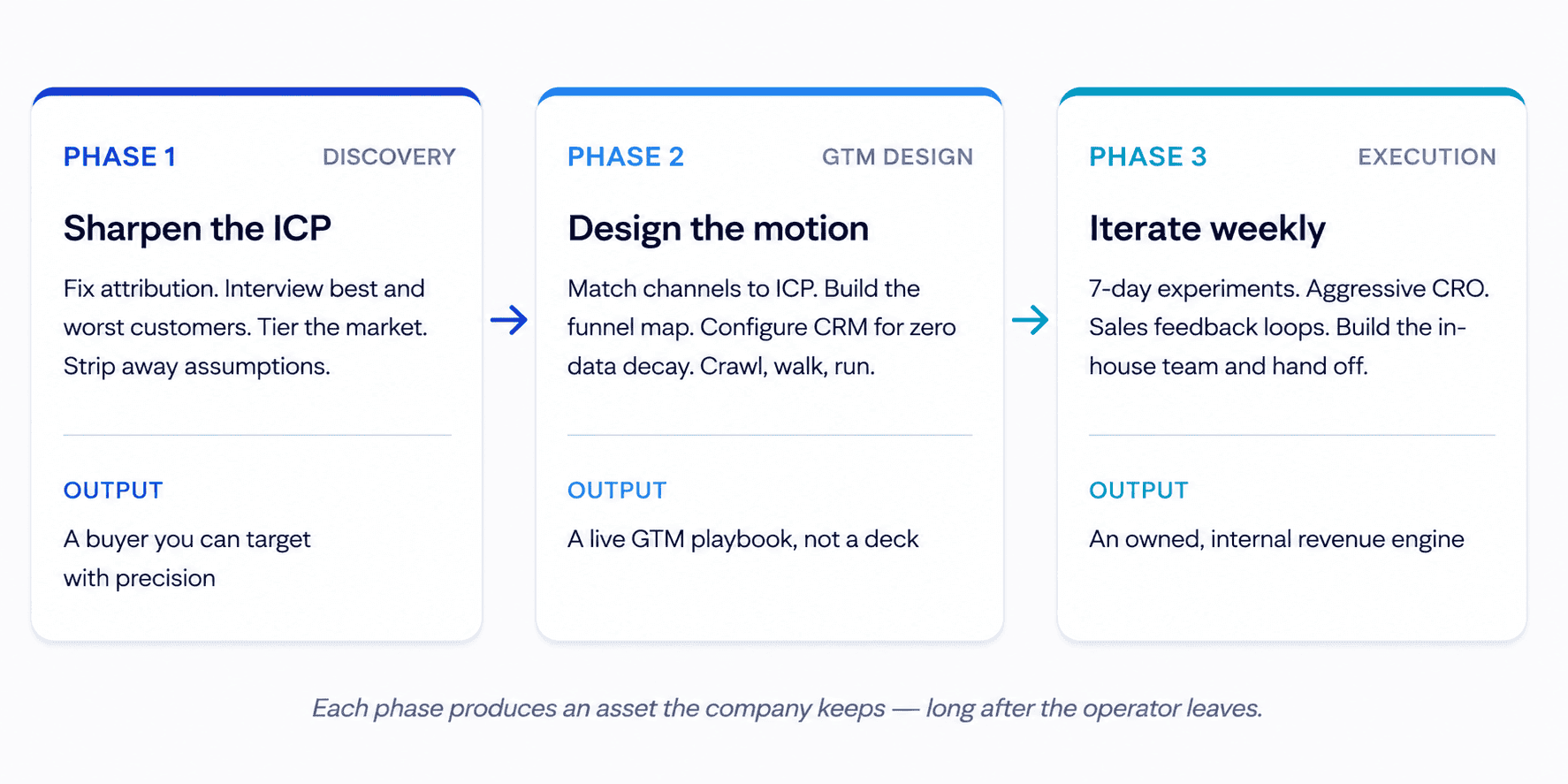
Phase 1 – Discovery and ICP Sharpening
Most startups skip the discovery because they feel they “already know” their customer. An operator knows that “feeling” is the leading cause of wasted ad spend. Phase 1 is all about stripping away the assumptions in order to find the truth in the data.
The Quantitative Audit: Before looking at the creative, the operator audits the data stack. Are your Google Tag Manager events firing correctly? Is your CRM capturing the original lead source, or is everything being attributed to “direct”? An operator fixes the attribution model so that every penny spent can be traced to a specific revenue outcome.
The Voice of the Customer: An operator conducts interviews with your best and worst customers. They look for the specific language customers use to describe their pain. This language becomes the copy for your high-converting landing pages.
ICP Tiering: Not all customers are equal. The operator segments your market into tier 1 (high LTV, fast close), tier 2 (sustainable), and tier 3 (high churn/low margin). This tiering helps in cutting all marketing efforts targeting tier 3.
Competitive Intelligence: Instead of a generic SWOT analysis, the operator performs a “tactical gap analysis.” What keywords are your competitors bidding on but failing to address in their landing pages? Where is their user experience breaking down? This helps us in building our market development strategy in those gaps.
Phase 2 – GTM Motion Design
In this phase, the operator moves beyond the “what” and focuses on the “how.” The operator is not just picking channels; they are designing a cohesive startup growth execution model that ensures every marketing penny is a direct investment in your company’s valuation.
Applying ICP-First to Channel Selection: The most common mistake B2B SaaS makes is selecting a channel because it is “popular” (e.g., “everyone is on LinkedIn”). An operator rejects this. Instead, the operator uses the sharpened IPC from Phase 1 to determine channel-motion fit.
High-ACV SLG (Sales-Led Growth): If your product costs $3K+ annually, the operator designs a motion focused on Account-Based Marketing (ABM). An operator doesn’t target “comapnies”; they target specific buying committees, such as, the CFO, the CTO, and the end-user, with tailored messaging that addresses their unique departmental plans.
Low-ACV PLG (Product-Led Growth): If you are a high-volume, low-cost tool, the operator focuses on virality and SEO-driven demand capture. The principle of ICP-First here means identifying the exact “Aha!” moment that turns a free user into a paid subscriber and builds the GTM motion around that specific friction point.
Strategy and Execution Under One Roof: Traditional agencies often suggest tools they are partners with. An operator builds a stack that serves revenue-driven execution. Because the operator is responsible for both the strategy and the clicking of the buttons. They ensure:
Zero Data Decay: They configure your CRM (HubSpot/Salesforce) so that the "original source" and “latest source” of a lead are never lost. This is critical for Principle 4 (Revenue Metrics), as it allows the board to see exactly which campaigns are driving closed-won deals.
The Scrappy Automation Pivot: Following Principle 5 (Stage-Appropriate Playbooks), the operator might initially set up manual lead routing. As the motion proves itself, they transition this into automated lead scoring and “fast-track” demo booking. This ensures you don’t over-engineer your stack before you have proven the motion works.
Bridging the Marketing Strategy Decks vs. Revenue-Driven Execution Gap: Phase 2 is where the operator kills the “static deck.” Instead of a 50-page PowerPoint that no one reads, the operator produces a Live GTM Playbook.
Dynamic Funnel Mapping: The operator maps the “micro-conversions” required to move a lead from “curious” to “customer.”
Step A: Download a technical whitepaper (demand generation).
Step B: Attend a live “comparison” webinar (demand capture).
Step C: Request a custom ROI calculation (sales enablement).
Embedded Sales Alignment: The operator doesn’t just hand off leads; they design the sales playbook that goes with them. This includes the email sequences, the discovery call scripts, and the objection-handling docs, ensuring that Principle 2 (Strategy/Execution unity) extends all the way to the sales floor.
Revenue Metrics: In Phase 2, the operator defines the “unit economics of growth.” An operator sets up a dashboard that focuses on Stage-Appropriate success markers:
Pipeline Velocity: How fast are leads moving from “first touch” to “signed contract”?
Payback Period: How many months of revenue does it take to recoup the CAC for a single customer?
LTV/CAC Ratio: is the growth sustainable? An agency might show you “cost per lead” (CPL), but an operator shows you the cost per opportunity (CPO) and the payback period, allowing the founder to make informed decisions about raising their next round of extending their runway.
Principle 5 In Action: The GTM Motion Design concludes with a tiered execution plan. The operator does not launch 10 channels at once.
The Crawl Phase (Weeks 1-4): Execute “unscalable” outreach. Manual LinkedIn messages, founder-led webinars, and direct community engagement. This validates the “ICP-First” messaging.
The Walk Phase (Week 5-12): Introduce paid demand capture (Google Search) and automated outbound. An operator begins to build the embedded growth team for startups by documenting these wins.
The Run Phase (Month 4+): Scale the winners. This is where we pour fuel on the fire, knowing that the foundation is solid and every penny spent has a high probability of returning as a revenue.
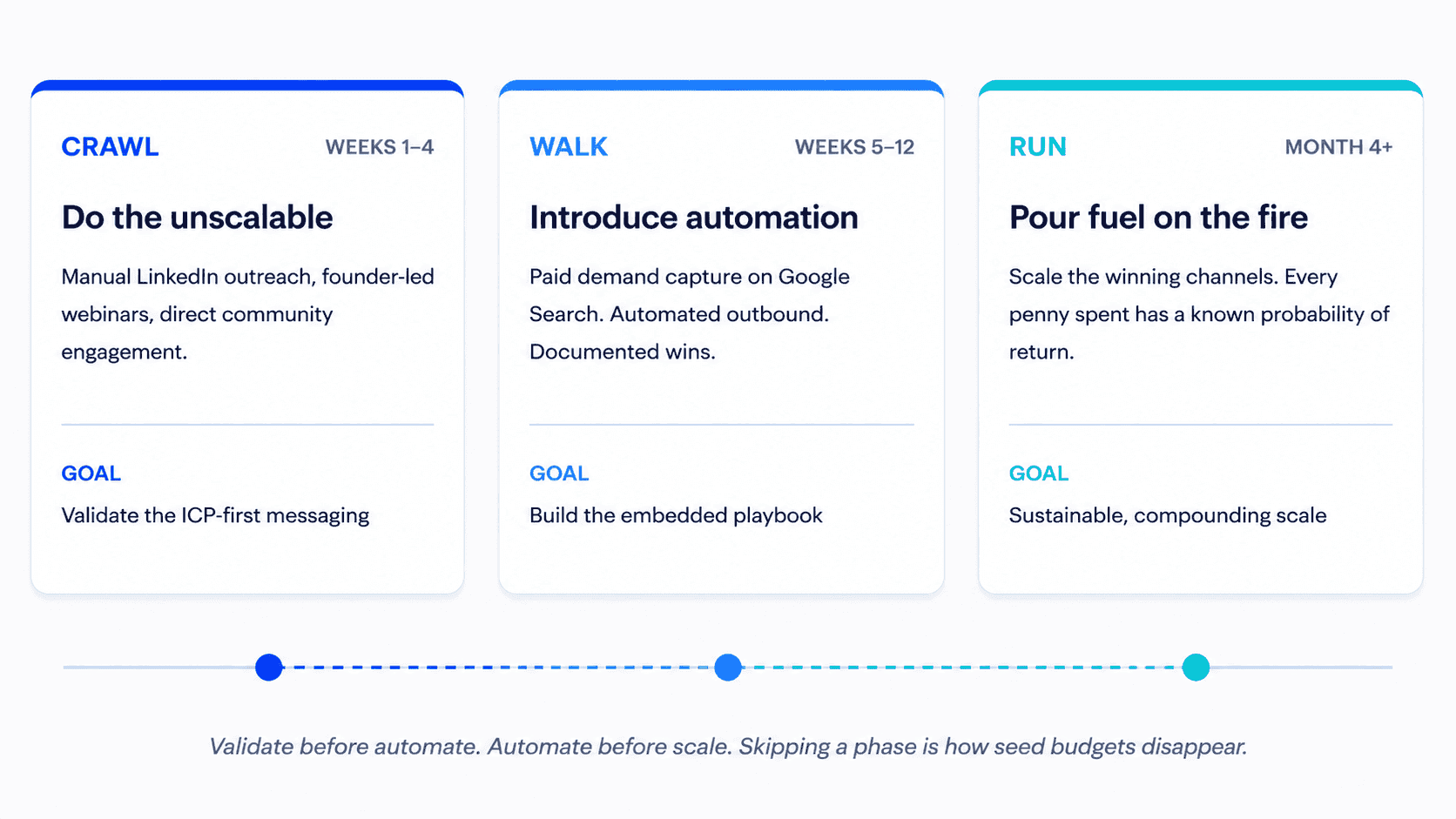
By integrating these principles into Phase 2, the operator ensures that your startup isn't just "doing marketing,” it is building a professional, high-output revenue engine.
Phase 3 – Execution and Iteration
This is where Operator-Led Growth truly separates itself. This isn’t a “monthly report” model; it is a daily execution model. The “operator” becomes an embedded growth team for startups. They launch the ads, write the copy, and build the automation. Every week, they iterate based on hard data, not “gut feelings.”
The Weekly Growth Sprint: The operator runs 7-day experiments. An operator doesn’t wait for a month to see if an ad works. If the Click-Through Rate (CTR) is low after 48 hours, they kill the creative and pivot. This speed is why funded startups scale faster under this model.
Aggressive Conversion Rate Optimization (CRO): Most agencies focus on sending traffic. An operator focuses on converting it. They run split tests on:
High-friction vs. Low-friction forms: Does asking for a phone number drop conversions by 40%? An operator finds out.
Social proof placement: An operator tests where case studies and logos drive the most trust.
Value-based pricing displays: An operator tests how different pricing tiers impact the “sign-up” rate.
The Sales Feedback Loop: In a B2B SaaS context, the operator listens to sales calls. If a prospect says, “I don’t understand how your API works,” then the operator creates a technical guide the next day to prevent that objection from any future leads. This is embedded growth team work at its finest.
The Nurture & Retention Automation: Acquisition is only half the battle. The operator builds automated “resurrection” flows for lost leads and “onboarding” flows for new users to reduce churn. The operator focuses on the entire LTV, not just the first click.
Hiring and Handoff: The final part of Phase 3 is making the operator redundant. An operator helps the founder write the job descriptions, interview the candidates, and train the full-time in-house team. The operator leaves you with a documented playbook so the growth doesn’t stop even when they leave.
When Should a Startup Switch to an Operator-Led Model?
Signs You’ve Outgrown Consulting
If you have a strategy folder full of beautiful PDFs that no one has opened in three months, you have outgrown consulting. You don’t need more “what”; you need “how.”
Signs Your In-house Team Needs Operator Support
Often a founder hires a junior marketing manager as their first hire. That person is great at execution but lacks the strategic seniority to build a startup growth execution model. An operator can mentor that hire, providing the “Fractional CMO” level leadership they need.
Conclusion
The goal of any operator vs. consultant for startups discussion should be the long-term health of the company. The biggest failure of the traditional agency model is that it creates dependency.
Operator-led Growth does the opposite: It creates capability. By the time an operator’s engagement is finished, the startup doesn’t just have more customers; it has a permanent, internal growth engine that is owned entirely.
FAQ
What makes an operator different from an agency?

Can early-stage startups afford operator-led growth?
How do I measure the success of an operator-led engagement?
Still stuck with strategy decks but no real growth?
Work with an operator-led growth team that fixes GTM bottlenecks, lowers CAC, and turns strategy into revenue.
Book a Growth Strategy Call